Being Wrong: Adventures in the Margin of Error by Kathryn Schulz
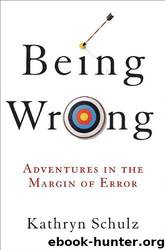
Author:Kathryn Schulz [Schulz, Kathryn]
Language: eng
Format: epub
Tags: General, Philosophy, Social Science, Anthropology, Psychology, Decision-Making & Problem Solving, Education, Psychological aspects, Movements, Applied Psychology, Errors, Humanism, Decision-making - Psychological aspects, Philosophical anthropology, Fallibility
ISBN: 9780061176043
Publisher: HarperCollins
Published: 2010-06-08T04:00:00+00:00
The word “witness” derives (obviously enough when you think about it, although I for one never had) from the word “wit.” Today we mostly use “wit” to describe a sharp sense of humor, but before that it referred to the mind—the meaning we invoke when we talk about keeping our wits about us. And before that, back when the word “witness” came into use, “wit” simply meant “knowledge.” We occasionally hear shades of that meaning today, too, which is why doing something unwittingly means doing it unknowingly.
A witness, then, is one who knows. This is an etymological fact, but also, and more profoundly, a psychological one. As we have seen, we take it for granted that we are authorities about events that we ourselves beheld or experienced. Like Wittgenstein’s two hands, the things we see with our own two eyes do not seem open to debate. We treat our life experiences, like our mathematical axioms, as givens—not as things that require verification, but as the foundation on which we build the rest of our knowledge of the world.
This use of private experience as a warranty of truth is elevated and formalized in the domain of the law. (And in my own domain. Journalists rely heavily on first-person reports to lend immediacy and legitimacy to their stories: hence all those bystanders providing “eyewitness accounts” on the evening news.) Eyewitness testimony is among the oldest forms of legal evidence, and by far the most compelling. In fact, only within the last twenty years or so has another kind of evidence emerged to challenge its authority: DNA testing.
DNA tests are not infallible. Any process controlled by human beings can be derailed by human error, and genetic testing is no exception. Biological material can be lost, mislabeled, or contaminated; lazy or incompetent technicians can bungle the tests; unscrupulous investigators can skew the results. But, given a system of checks and balances to detect and prevent these problems, DNA testing is the closest thing the legal system has to a silver bullet. It is relatively simple, totally replicable, has a very slim margin of error, and—unlike blood-typing and other earlier scientific evidence—it provides a virtually one-to-one match between the biological sample and the person from whom it came. (This is, after all, the same technology we trust to establish paternity and to ensure safe matches in organ donation.) It has been called, not without cause, a “revelation machine.”*
The introduction of DNA testing into the judicial system has created something of a standoff between one of the oldest and one of the newest forms of evidence. As judges and juries grow more educated about DNA, the science is starting to prevail, and it seems certain to win out in the long run. But eyewitness testimony remains powerful, and, in those cases where no DNA sample is available, it carries the day. Of all the kinds of evidence presented in court—physical evidence, biological evidence, character evidence, expert testimony, written documents—a confident eyewitness remains the single most powerful predictor of a jury’s final verdict.
Download
This site does not store any files on its server. We only index and link to content provided by other sites. Please contact the content providers to delete copyright contents if any and email us, we'll remove relevant links or contents immediately.
| Administration & Medicine Economics | Allied Health Professions |
| Basic Sciences | Dentistry |
| History | Medical Informatics |
| Medicine | Nursing |
| Pharmacology | Psychology |
| Research | Veterinary Medicine |
The Art of Thinking Clearly by Rolf Dobelli(10495)
The 5 Love Languages: The Secret to Love That Lasts by Gary Chapman(9820)
Mindhunter: Inside the FBI's Elite Serial Crime Unit by John E. Douglas & Mark Olshaker(9350)
Becoming Supernatural by Dr. Joe Dispenza(8225)
Nudge - Improving Decisions about Health, Wealth, and Happiness by Thaler Sunstein(7712)
The Road Less Traveled by M. Scott Peck(7606)
Mastermind: How to Think Like Sherlock Holmes by Maria Konnikova(7353)
Enlightenment Now: The Case for Reason, Science, Humanism, and Progress by Steven Pinker(7316)
Win Bigly by Scott Adams(7204)
The Way of Zen by Alan W. Watts(6621)
Factfulness: Ten Reasons We're Wrong About the World – and Why Things Are Better Than You Think by Hans Rosling(4747)
The State of Affairs by Esther Perel(4725)
Gerald's Game by Stephen King(4659)
Man's Search for Meaning by Viktor Frankl(4612)
The Confidence Code by Katty Kay(4268)
Thinking in Bets by Annie Duke(4233)
The Healing Self by Deepak Chopra(3588)
Hidden Persuasion: 33 psychological influence techniques in advertising by Marc Andrews & Matthijs van Leeuwen & Rick van Baaren(3570)
The Worm at the Core by Sheldon Solomon(3493)
